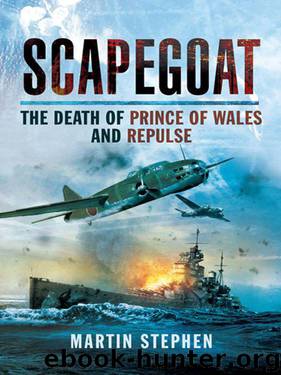
Scapegoat: The Death of Prince of Wales and Repulse by Dr Martin Stephen
Author:Dr Martin Stephen [Stephen, Dr Martin]
Language: eng
Format: epub, mobi
Tags: HISTORY / Military / Naval, Bisac Code 1: HIS027150
ISBN: 9781473840126
Publisher: Pen and Sword
Published: 2014-08-30T07:00:00+00:00
Chapter 8
Intelligence, SS Automedon and ‘Matador’
There has long been a theory that the British knew more about Japanese intentions in the Malayan Peninsula in 1941 than was admitted at the time. There is the story, reported above, that Singapore intercepted Japanese sighting reports of Force Z. There is also a story which cannot now be verified because the source of it, an officer who survived the sinking of Prince of Wales, died before his account could be checked:
‘There is also hearsay evidence that the Intelligence on Admiral Phillips’s staff found, on his return to Singapore after the sinkings, that the naval staff ashore had known of the presence of Japanese torpedo-bombers in Indo-China while Force Z had been at sea but had not thought it necessary to send a warning signal.’1
Another historian claims that the British had a limited ability to read Japanese naval signals, and that the British knew four hours in advance an attack would be launched against Force Z. Unfortunately, the source for this allegation is not made clear.2
As we have seen, there was confusion in many levels of communication, including between the signals Intelligence division and the army and RAF. It is at least possible that vital intelligence was not passed on to both commanders in Singapore and to Force Z. This matters because had Phillips been more clearly informed he would have been extremely unlikely to stay around Kuantan as he did, but chosen instead to make maximum speed back to Singapore. It also needs to be remembered that the delay off Kuantan was at the behest of Captain Tennant of Repulse, and did not originate with Phillips.
What is clear beyond reasonable doubt is that Phillips was woefully ill-informed about the range and power of Japanese aircraft. This is dealt with more fully in a chapter below, but in essence the Royal Navy based its assessment of Japanese capabilities round its carrier-based biplane, the ‘Stringbag’ or Fairey Swordfish, and the land-based Beaufort. Both had significantly shorter range than their Japanese counterparts. British experience pointed to 200 miles as the standard reach of torpedo bombers, and that the risk from them at 400 miles or over was negligible. The British had no idea that Japanese aircraft were capable of at least twice that range, and could launch torpedoes at twice the height and twice the speed of their Fleet Air Arm equivalents. It is interesting that this failure to recognize the strength of Japanese materiel did not extend to Japanese submarines, which were regarded as a potent and effective threat. As for surface ships, the last ship built for Japan in Britain was the battle-cruiser Kongo in 1910. Ironically, it was this vessel the crews of Force Z were told they were most likely to face if they met any Japanese surface forces, and the men were understandably optimistic about the outcome of a duel between Britain’s most modern battleship and a battle-cruiser, albeit modernized, that predated the First World War.
Thus though dismissal of Japanese materiel
Download
Scapegoat: The Death of Prince of Wales and Repulse by Dr Martin Stephen.mobi
This site does not store any files on its server. We only index and link to content provided by other sites. Please contact the content providers to delete copyright contents if any and email us, we'll remove relevant links or contents immediately.
| Africa | Americas |
| Arctic & Antarctica | Asia |
| Australia & Oceania | Europe |
| Middle East | Russia |
| United States | World |
| Ancient Civilizations | Military |
| Historical Study & Educational Resources |
The Radium Girls by Kate Moore(12036)
100 Deadly Skills by Clint Emerson(4932)
Rise and Kill First by Ronen Bergman(4797)
The Templars by Dan Jones(4695)
The Doomsday Machine by Daniel Ellsberg(4493)
The Rape of Nanking by Iris Chang(4224)
Killing England by Bill O'Reilly(4008)
Stalin by Stephen Kotkin(3973)
Hitler in Los Angeles by Steven J. Ross(3949)
12 Strong by Doug Stanton(3555)
Hitler's Monsters by Eric Kurlander(3352)
Blood and Sand by Alex Von Tunzelmann(3207)
The Code Book by Simon Singh(3197)
Darkest Hour by Anthony McCarten(3137)
The Art of War Visualized by Jessica Hagy(3014)
Hitler's Flying Saucers: A Guide to German Flying Discs of the Second World War by Stevens Henry(2759)
Babylon's Ark by Lawrence Anthony(2686)
The Second World Wars by Victor Davis Hanson(2529)
Tobruk by Peter Fitzsimons(2521)
